Mount Rainier
National Park Service U.S. Department of the Interior
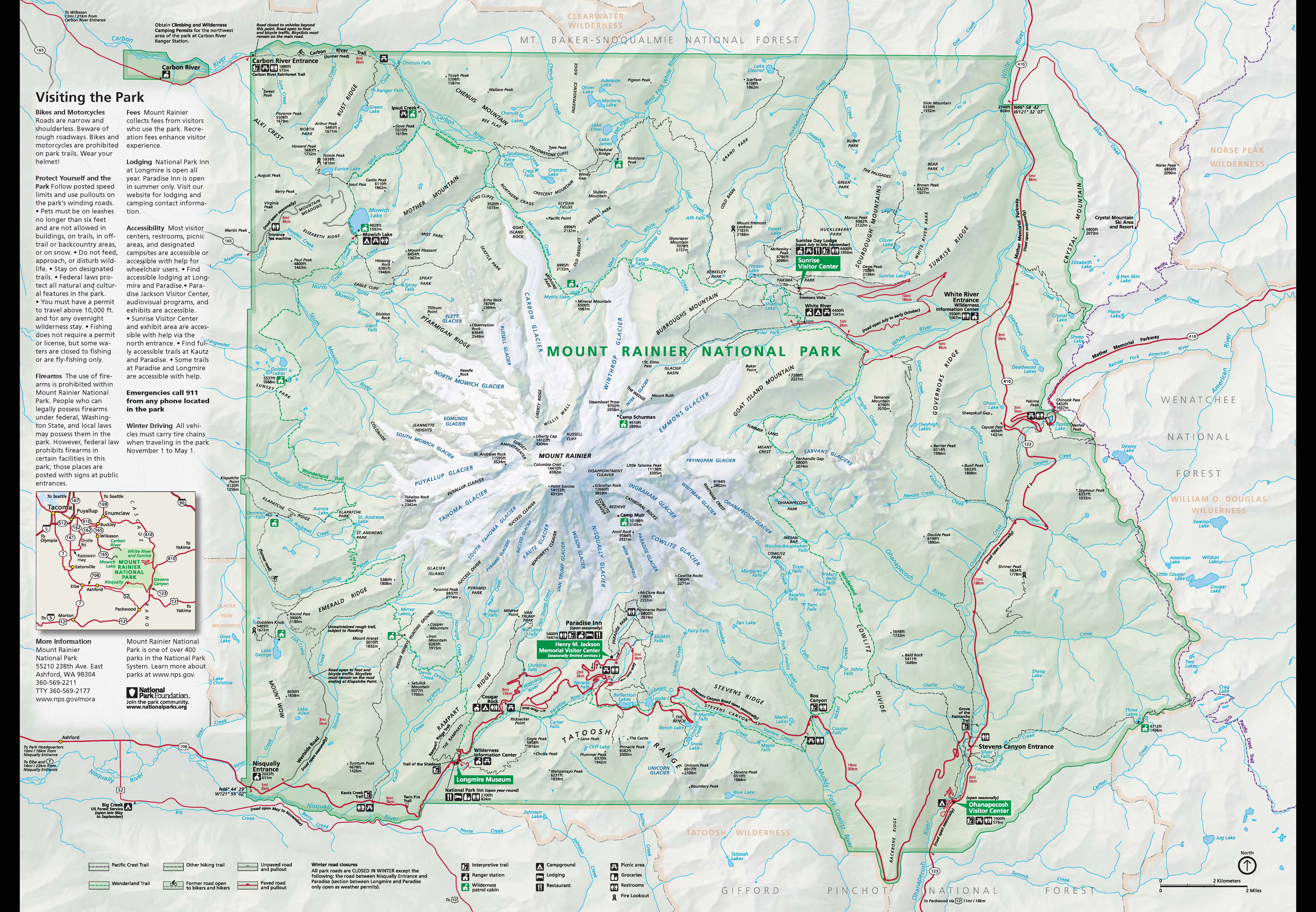
Mount Rainier National Park Washington
Unforgettable Destinations
Carbon River
Longmire
Paradise
Ohanapecosh
Sunrise
Accessible year-round. Snowshoe or cross-country ski during winter. Stroll the edge of a meadow where history meets nature. Day hike to expansive vistas. Step back in time; discover rustic park architecture along the Longmire Historic Walking Tour. Stay a night at the historic National Park Inn. From the porch, admire the sunset’s glow on the mountain.
During summer, hike the maintained trails around meadows, streams, and water-falls. Watch and listen for wildlife—bears, grouse, butterflies, marmots, and more. Explore exhibits at the visitor and climb-ing information centers. Rest a night or have a snack at the historic Paradise Inn. Grab a sled and head for Paradise’s winter snowplay area, set up a snow camp, ski, or snowboard.
Meander moist, moss-carpeted paths through temperate rainforest. Discover the dynamic forces of a glacial river. Mountain-bike a historic road. Spend a night in the backcountry. Visit Mowich Lake—the park’s largest and deepest lake. Camp near the lake or enjoy its serenity from a canoe. Fish the deep waters. Hike to subalpine meadows.
Old growth forest is the signature of Ohanapecosh. Ancient trees, wildlife, waterfalls, spring wildflowers, and fall mushrooms abound. The Ohanapecosh River—transparent green or blue depend-ing on the light and your perspective— surrounds the Grove of the Patriarchs. Many day hikes begin at Ohanapecosh. Camp or picnic in the campground.
Sunrise, the highest point in the park reachable by car, offers a panoramic view of Mount Rainier and surrounding peaks. Day hikes lead to glaciers, lakes, and meadows. Dig into geology at the visitor center. Discover the rustic architecture and history of Sunrise. Enjoy a snack at the day lodge. Camp nearby at White River Campground.
Longmire is a year-round destination.
Capture the lush vegetation and giant old growth trees of the rainforest.
Enjoy unsurpassed, panoramic views while hiking amid resplendent subalpine meadows.
Camp, hike, and explore beneath towering old growth trees.
Visit Paradise meadows when they are at their most spectacular.
Meet the People People have been coming to Mount Inspired, mountain clubs, scientists, Rainier for more than 9,000 years. and communities successfully Archeological findings suggest that lobbied Congress to create Mount Native Americans hunted, gathered, Rainier National Park in 1899. and conducted spiritual and ceremo-nial activities on the mountain. Their descendants maintain a special connection with the mountain to the present day. In the late 1800s, miners, entrepre-neurs, and tourists recognized the mountain’s potential to provide wealth and recreation. They came with the hope to prosper, to recreate, and simply to breathe the clear mountain air.
These projectile points, made 2,500 years ago, reveal a chapter of the park’s history. NPS
Witness Change Though the mountain may convey a sense of permanence, Mount Rainier is anything but permanent. Ice and rock continually break away from the peak. Glaciers and rivers transport debris and water down the mountain, and often wreak havoc with roads and park buildings. Subalpine meadows, buried beneath deep snow most of the year, rapidly bloom once the snow melts. Animals must adapt to this ever-changing environ-ment, migrate, or die. As Earth’s temperature rises, it is unclear how such a change will affect the mountain’s dynamic forces, its plants, animals, or ourselves. ✩GPO:20xx—xxx-xxx/xxxxx Printed on recycled paper.
Wildlife habitat and ecosystems shift with changes in climate. ABOVE: © JAY THOMPSON; RIGHT: © THORSTEN SCHEUERMANN
A mountain of immeasurable inspiration, Mount Glaciers, massive rivers of ice up to 750 feet deep, last two months. Adaptations that have taken centu-Rainier is the center of the nation’s fifth national flow down the rocky slopes. Yet, on the summit, ries to develop prove crucial in a race for survival. park. It is a place of discovery and of personal steam escapes from deep within the mountain’s Profuse wildflower displays and pollinating insects triumphs, where family traditions endure. core, a reminder that it is still an active volcano. bring life to the meadows. Birds and mammals for-age on the abundance before winter quickly returns. At 14,410 feet, the mountain is the tallest volcano in Above Mount Rainier, millions of stars illuminate the the Cascade Mountain Range and the most glaciated night sky. The park minimizes the use of artificial Entering the park is a step back in time—a portal As global development increases, this mountain peak in the continental United States. Basalt col- light. This preserves darkness, through which into Mount Rainier National Historic Landmark remains steadfast, a place where people can umns and other remnants of early eruptions and constellations and planets are remarkably visible. District. Roads, buildings, and other structures were reconnect with what is important in their lives. lava flows reveal Mount Rainier’s ancient geologic designed nearly one hundred years ago. Massive history. In spring, snow melts first in the foothills. Beneath logs and round river boulders characterize early the old growth forest, flowers bloom and ferns un- national park rustic architecture, which harmonizes furl. Across the subalpine region, summer may only with the park’s natural scenery.
Of all the fire mountains which like beacons, once blazed along the Pacific Coast, Mount Rainier is the noblest. John Muir
Explore Wilderness Home to animals seen and unseen, Mount Rainier’s wilderness is an evolving landscape of forests, mead-ows, glaciers, and craters. Wilderness performs functions essential to life on Earth. Melting snow produces fresh water. Plants pump oxygen into the atmosphere. Protecting the mountain’s wild places, and the wild-life and the natural processes they support, will become ever more essential in our developing world. Beyond the roads and parking lots is wild land. Over 97 percent of the park is wilderness legally protected by the 1964 Wilderness Act—untram-meled, free from development; a place to recreate and find solitude.
Snowshoeing in the park (above). The park’s wilderness is habitat to wildlife such as this spotted owl (right). ABOVE: © JOHN T. STROTHER; RIGHT: NPS / KEITH BAGNALL
Hike amid ancient trees and past waterfalls on the Eastside Trail. NPS / CHRIS ROUNDTREE
Moving up Mount Rainier’s glaciers and lava ridges, their routes illuminated by headlamps, climbers travel steadily toward the summit under a star-filled sky (above). © JEFF BERKES
Mow ich L ake NPS /MEL INDA SCHM ITT
chs of the Patriar Grove NPS / CHRIS ROUNDTREE
Mo untain go NPS at / JOHN CHAO
eer Black-tailed d © JEREMY SELL
nd Trai Wonderla STORINO © NICK PO
Discoveries Await
Winter at Paradise © DEBY DIXON
BACKGROUND PHOTO: NPS / CHRIS ROUNDTREE
Black bear
l
View fro m R ickseck er Poi nt
NPS / STEVE RED MAN Refl n Stevens ection Box Canyon o Lakes NPS / DANIEL KEE BLER Mount Rainier from anyon Road C Tipsoo Lake EDMAN NPS / STEVE R DONNA DANNEN © KARTHIKEYAN ERODE